Industrial Engineering
Predictive maintenance with the data you already have
Predictive maintenance does not have to start with new sensors and a big AI project. How to begin with the maintenance logs, downtime records and machine counters you already have.
- Mehdi Hassanbeigi
- 25 November 2026
- 1 min read

Many factories assume predictive maintenance needs expensive sensors and a large AI project. In practice, the first and often most valuable steps can be taken with data that already exists: maintenance logs, downtime reports, machine counters and operator notes.
The challenges
- Scattered, incomplete records. Repairs are recorded on paper, in spreadsheets or not at all, and everyone records them differently.
- Few failure examples. Serious failures are rare, which makes it hard to train a model on them.
- Alerts nobody believes. A system that raises too many false alarms is soon ignored.
- Analysis far from the workshop. A forecast is only worth something if it reaches the maintenance team in time and in a form they can act on.
How we solve it
- Find the critical assets. We rank machines by downtime and cost to see which few cause most of the losses.
- Build one maintenance history. Existing records are cleaned and combined into a single structured history for each machine.
- Start with simple indicators. Mean time between failures, repair times, trends and threshold rules often give early warnings on their own.
- Add models where the data supports them. Anomaly detection on signals such as vibration or temperature is added only for equipment with enough data.
- Close the loop with technicians. Alerts go straight into the maintenance workflow, and technician feedback steadily reduces false alarms.
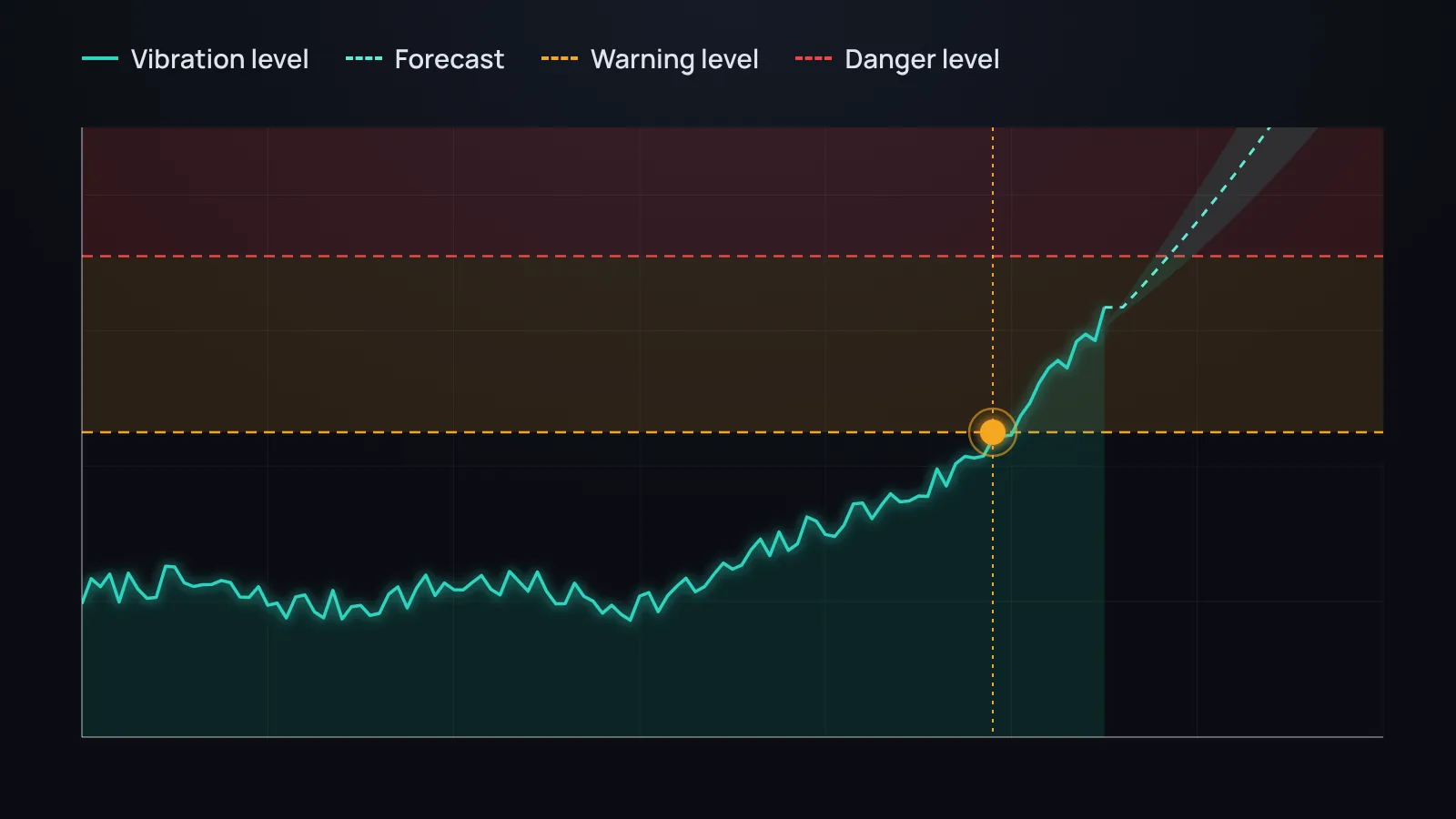
The chart shows the idea on an example vibration signal: a slow upward trend crosses the warning level well before it reaches the danger level, leaving time to plan the repair instead of reacting to a breakdown.
- Predictive maintenance
- Industrial engineering
- Industrial data